Most businesses have no idea what an AI automation agency builds. Here is what happens behind the scenes, what it costs, and how to tell good agencies from bad ones.
Let’s Clear Something Up
Most people hear “AI automation agency” and picture either a giant consultancy charging 200 EUR/hour for PowerPoint slides, or a freelancer duct-taping Zapier workflows together. Neither is accurate.
An AI automation agency sits in a very specific gap. We are not a traditional software house building full applications from scratch. We are not a consultancy that hands you a PDF and walks away. We build targeted AI systems that plug into your existing business and automate the work your team is doing manually, over and over, every single day.
Think of it like this: a software house builds you a house. A consultancy tells you which house to buy. An AI automation agency installs the plumbing, the electrical, the heating. The stuff that makes the house actually work without someone manually turning every valve.
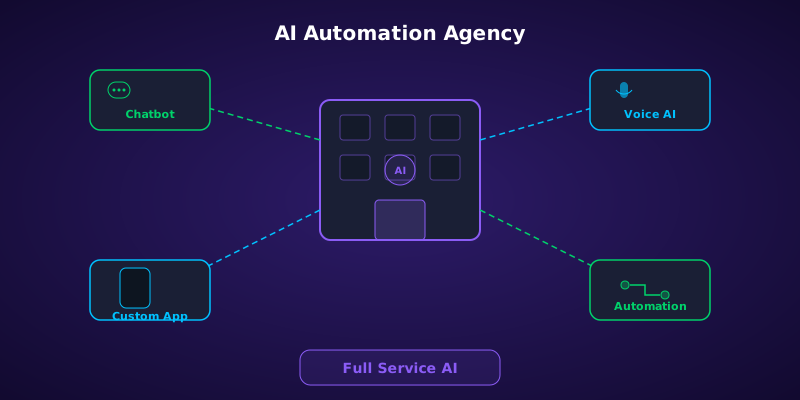
The 5 Things an AI Automation Agency Actually Builds
1. AI Chatbots
Not the terrible “click option A or B” bots from 2018. Modern AI chatbots are trained on your specific business data, your products, your pricing, your policies. They handle real conversations in natural language.
A dental clinic in Antwerp came to us because their receptionist was spending 3 hours a day answering the same 12 questions. Insurance coverage, parking directions, appointment availability. We built a chatbot trained on their entire FAQ, connected it to their booking system, and deployed it on their website and WhatsApp. Within the first month, 73% of incoming questions were resolved without any human involvement. The receptionist got her mornings back.
2. AI Voice Agents
Voice agents pick up the phone when your team cannot. They handle appointment scheduling, order status inquiries, basic qualification calls. They sound natural, they understand context, and they work at 2 AM on a Sunday.
A logistics company was losing leads because calls came in after hours and went to voicemail. Nobody calls back a logistics company from voicemail. We deployed a voice agent that answers every call, captures the shipment details, provides instant quotes for standard routes, and routes complex requests to the sales team the next morning. They estimated a 35% increase in captured leads within the first quarter.
3. Workflow Automations
This is where the real efficiency gains hide. Every business has processes that involve copying data from one system to another, sending follow-up emails, updating spreadsheets, generating reports. All of it can be automated.
A real estate agency was manually entering every new listing into their CRM, their website, three property portals, and a shared spreadsheet. That is five places for one listing. We built a workflow where the agent fills in one form, and the listing automatically populates everywhere else. Photos get resized and watermarked. The description gets translated into Dutch and French. What used to take 45 minutes per listing now takes about 5.
4. Custom AI-Powered Applications
Sometimes the tool you need simply does not exist. Off-the-shelf software gets you 70% of the way, but that last 30% is where your competitive advantage lives.
An e-commerce brand needed a system that could analyze customer reviews across their products, identify recurring complaints, and flag quality issues before they became return spikes. No existing tool did exactly this for their niche. We built a custom application using large language models that processes reviews daily, categorizes sentiment by product and issue type, and sends a morning digest to their product team. They caught a packaging defect within three days of launch that would have taken weeks to surface through their old process.
5. System Integrations
Most businesses run 8 to 15 different software tools. Very few of them talk to each other properly. Integrations connect your CRM to your invoicing, your chatbot to your calendar, your ad platform to your lead scoring.
A law firm was using separate systems for client intake, document management, billing, and communication. Every new case required manual data entry across four platforms. We connected everything so that when a new client fills out the intake form, their profile auto-populates in the document system, a billing record is created, and the assigned attorney gets a Slack notification with all the case details. Total time saved per new case: about 25 minutes.
How to Tell a Good Agency from a Bad One
Red Flags
They lead with technology, not with your problem. If the first meeting is about GPT-4 and fine-tuning and vector databases, run. A good agency asks what is broken in your business before talking about solutions.
They promise results in days. Real AI automation takes 2 to 6 weeks minimum. Discovery, building, testing, iterating. Anyone promising a production-ready system in 48 hours is selling you a template they will barely customize.
They cannot show you similar work. Case studies matter. If they have never built a chatbot for a service business and you are a service business, you are paying for their learning curve.
They do not mention maintenance. AI systems need monitoring, retraining, and updates. If there is no post-launch support plan, you will have a broken bot within three months.
Green Flags
They ask a lot of questions upfront. How many inquiries do you get per day? What does your current process look like? What tools are you already using? The more they ask, the better the result.
They scope small first. Good agencies suggest a pilot project. Automate one process, prove the ROI, then expand. Not a 50,000 EUR “digital transformation” engagement.
They give you ownership. You should own your data, your models, your integrations. If the agency disappears tomorrow, your systems should still work.
They are honest about limitations. AI is not magic. A good agency will tell you when a simpler solution exists or when automation is not the right fit.
What Does It Typically Cost?
Pricing varies based on complexity, but here are realistic ranges for SMBs in Europe:
- AI Chatbot (trained on your data, deployed on website + WhatsApp): 1,500 to 5,000 EUR
- Voice Agent (appointment booking or lead qualification): 3,000 to 8,000 EUR
- Workflow Automation (connecting 3-5 systems): 1,000 to 4,000 EUR
- Custom AI Application: 5,000 to 20,000 EUR depending on scope
- System Integration (per integration): 500 to 2,500 EUR
Most agencies also charge a monthly maintenance fee between 100 and 500 EUR for monitoring, updates, and support. This is normal and honestly necessary. AI systems are not static.
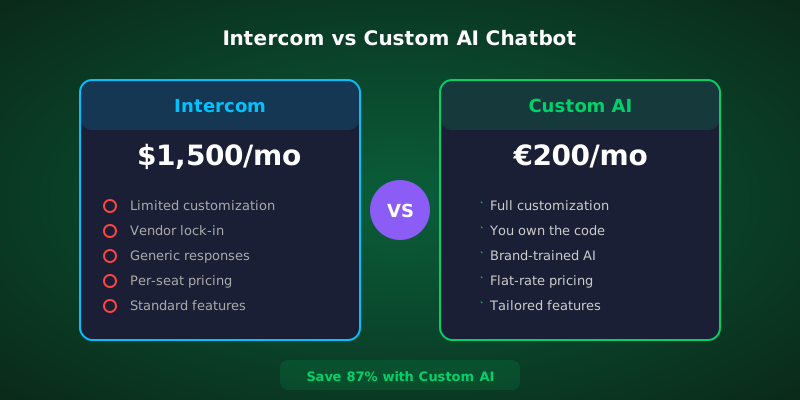
If someone quotes you 200 EUR for a “custom AI chatbot,” you are getting a ChatGPT wrapper with your logo on it. If someone quotes you 100,000 EUR for a basic workflow automation, they are billing you for their office rent in a city center.
When You Actually Need an Agency (And When You Do Not)
You need an agency when:
- Your team spends more than 10 hours per week on repetitive tasks that follow clear rules
- You are losing leads or customers because you cannot respond fast enough
- You need AI trained on your specific business data, not generic responses
- You need systems connected that do not have native integrations
- You have tried DIY tools and hit their limits
You probably do not need an agency when:
- Your process can be solved with a simple Zapier automation or a Google Form
- You have fewer than 20 customer interactions per day
- Your needs are fully covered by existing software you just have not set up properly
- You are not clear on what you want to automate (figure that out first, then call)
Being honest here: not every business needs custom AI. Some businesses need to set up their existing CRM properly before adding automation on top. A good agency will tell you this. A bad one will sell you a system you do not need.
Where to Start
If you have read this far and recognized your business in any of these examples, the first step is simple. Map out the three tasks your team spends the most time on. Write down exactly what those tasks involve, step by step. Then have a conversation with an agency about which ones are worth automating.
At SORIX, we start every project with a free discovery call. No slides, no jargon. Just a conversation about what is costing you time and money, and whether AI can realistically fix it. If it can, we will scope it. If it cannot, we will tell you.
Book a free discovery call and let’s figure it out together.
Writer at SORIX, the AI Automation Studio in Brussels. Building chatbots, voice agents, and automations for businesses across Europe and beyond.