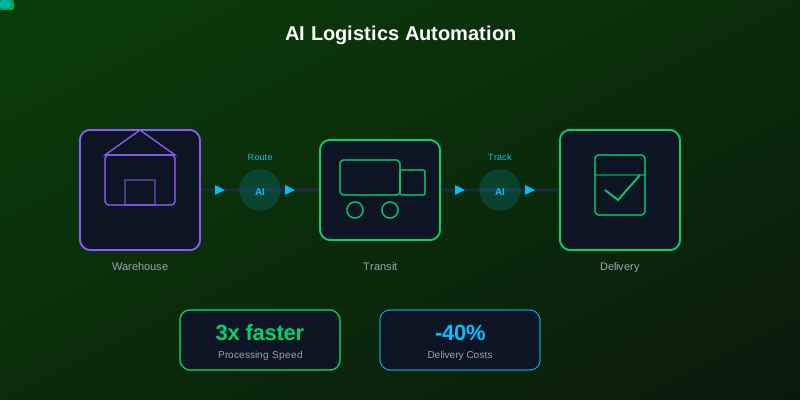
Streamline logistics operations with AI automation. From order processing to delivery updates, save 20+ hours weekly.
Logistics Is Drowning in Manual Processes
Logistics companies handle thousands of data points daily: orders, shipments, tracking updates, customer inquiries, invoices, and compliance documents. Most still rely on manual data entry, phone calls, and email chains. The result: errors, delays, and frustrated customers.
Where AI Automation Fits
Order Processing
Manual: Staff receives orders via email, phone, and portal. Manually enters into TMS. Validates addresses. Assigns carriers.
AI-powered: Orders from all channels are automatically captured, validated, and entered into your system. Address verification happens instantly. Carrier assignment follows your rules (cost, speed, reliability).
Time saved: 4 to 6 hours daily
Customer Communication
Manual: Customers call asking “Where is my shipment?” Staff checks tracking, calls back, sends emails.
AI-powered: Customers get proactive updates via WhatsApp/SMS. AI chatbot answers tracking questions instantly. Exception notifications sent automatically.
Time saved: 3 to 5 hours daily
Document Processing
Manual: BOLs, PODs, customs forms, and invoices processed by hand. Filed in folders or basic systems.
AI-powered: Documents scanned and data extracted automatically. Cross-referenced with orders. Filed and searchable instantly.
Time saved: 2 to 4 hours daily
Exception Management
Manual: Delays, damages, and missed deliveries require manual investigation and communication.
AI-powered: Exceptions detected automatically from tracking data. Customer notified proactively. Resolution options presented to operations team.
Time saved: 1 to 3 hours daily
Full Workflow Example
A typical order lifecycle, automated:
- Order received (email/API/portal) > AI extracts details
- Validation > Address verified, inventory checked
- Carrier assigned > Based on cost/speed rules
- Label generated > Sent to warehouse automatically
- Pickup scheduled > Carrier notified via API
- In-transit updates > Customer receives WhatsApp updates
- Delivery confirmed > POD processed, invoice generated
- Exception handling > AI detects delays, notifies relevant parties
Integration Points
AI connects your existing systems:
- TMS (Transport Management System)
- WMS (Warehouse Management System)
- Carrier APIs (PostNL, DHL, Bpost, DPD)
- Customer portals
- Accounting software
- Communication channels (email, WhatsApp, SMS)
ROI for a Mid-Size Logistics Company
| Metric | Before | After | Impact |
|---|---|---|---|
| Order processing time | 15 min | 2 min | 87% faster |
| Customer inquiries handled manually | 80/day | 20/day | 75% reduction |
| Data entry errors | 5% | 0.5% | 90% fewer |
| Customer satisfaction | 3.5/5 | 4.4/5 | +26% |
| Staff hours on admin | 160 hrs/week | 60 hrs/week | 63% reduction |
Implementation Approach
Phase 1 (Weeks 1-3): Customer communication automation (chatbot + proactive updates)
Phase 2 (Weeks 4-6): Order processing and document automation
Phase 3 (Weeks 7-9): Exception management and advanced workflows
Phase 4 (Ongoing): Optimization based on data and expanding to new use cases
Transform your logistics operations with AI automation designed specifically for transport and logistics companies.
Writer at SORIX, the AI Automation Studio in Brussels. Building chatbots, voice agents, and automations for businesses across Europe and beyond.