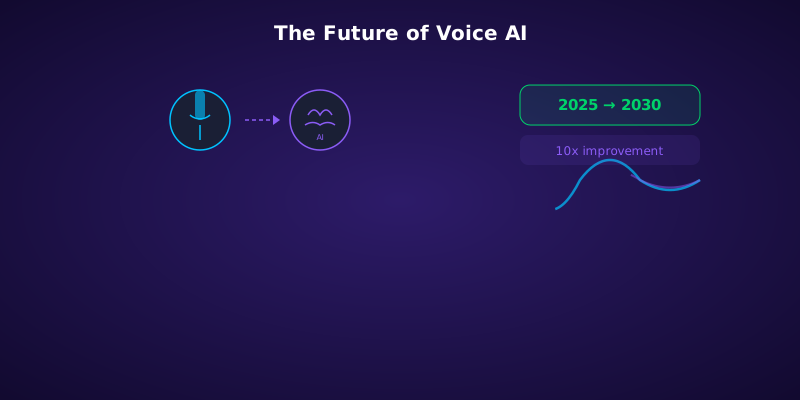
Where voice AI is heading in 2025 and beyond. Trends, capabilities, and what businesses should prepare for now.
Voice AI Has Changed Dramatically
Two years ago, voice AI meant robotic IVR systems that frustrated callers. Today, AI voice agents hold natural conversations that are often indistinguishable from human agents. The technology is advancing at a pace that will reshape customer service by 2026.
Current State (2025)
Voice AI today can:
- Understand natural speech with 95%+ accuracy
- Handle accents and dialects across languages
- Detect emotion and adjust tone accordingly
- Complete multi-step tasks (booking, troubleshooting, ordering)
- Transfer to humans seamlessly with full context
- Process calls in under 200ms latency
What Is Coming Next
Proactive Voice Outreach
Instead of just answering calls, voice AI will initiate them:
- Appointment reminders with rescheduling options
- Follow-up calls after service visits
- Renewal reminders before contracts expire
- Satisfaction surveys that feel like conversations
Emotion-Aware Responses
AI is getting better at detecting and responding to:
- Frustration (simplify language, offer escalation)
- Confusion (slow down, provide step-by-step guidance)
- Urgency (prioritize speed over pleasantries)
- Satisfaction (ask for reviews or referrals)
Multi-Modal Conversations
Voice AI will combine channels mid-conversation:
- “I will send you a link right now” (SMS during call)
- “Let me share a visual guide” (WhatsApp image during call)
- “Check your email for the confirmation” (triggered during conversation)
Hyper-Personalization
AI will recognize returning callers and personalize instantly:
- “Hi Sarah, calling about your appointment on Thursday?”
- Reference past interactions and preferences
- Predict the reason for calling based on history
Industry Impact Predictions
Healthcare: 60% of routine patient calls handled by AI by 2026 Retail: Voice commerce (ordering by phone) becomes mainstream Finance: AI handles 80% of balance inquiries and transaction questions Hospitality: Reservations and concierge services fully automated
Challenges Still to Solve
- Trust: Some demographics still prefer human agents
- Complex negotiations: AI struggles with nuanced back-and-forth
- Liability: Who is responsible when AI gives wrong information?
- Regulation: EU AI Act will impose transparency requirements
What Businesses Should Do Now
- Start with voice AI for simple use cases (booking, FAQs, routing)
- Build your knowledge base (AI is only as good as its training data)
- Collect call data (for training and improving AI over time)
- Plan your human-AI collaboration model (where does AI stop and humans start?)
The Competitive Advantage
Businesses that adopt voice AI now build a data advantage. Every call handled by AI generates training data that makes the system better. Early adopters will have significantly more capable systems by 2026.
Get started with voice AI today and position your business ahead of the curve.
Writer at SORIX, the AI Automation Studio in Brussels. Building chatbots, voice agents, and automations for businesses across Europe and beyond.