Everything you need to know about using AI for customer service. What works, what doesn't, real costs, and how to implement it without annoying your customers.
The Reality of AI Customer Service in 2025
Let’s skip the hype. AI isn’t replacing your support team. But it is handling 60-90% of incoming requests for companies that implement it properly. Gartner reported that 85% of customer interactions will be managed without a human by the end of 2025. The actual number is closer to 65% for most mid-size businesses, and that’s still a massive shift.
What changed? Language models got dramatically better at understanding messy, incomplete, emotionally charged customer messages. Two years ago, an AI would choke on “my order never came and I’m literally about to lose it.” Now it understands the intent, checks the order status, and responds with genuine empathy.
The companies winning with AI customer service aren’t the ones automating everything. They’re the ones automating the right things and keeping humans where humans matter.
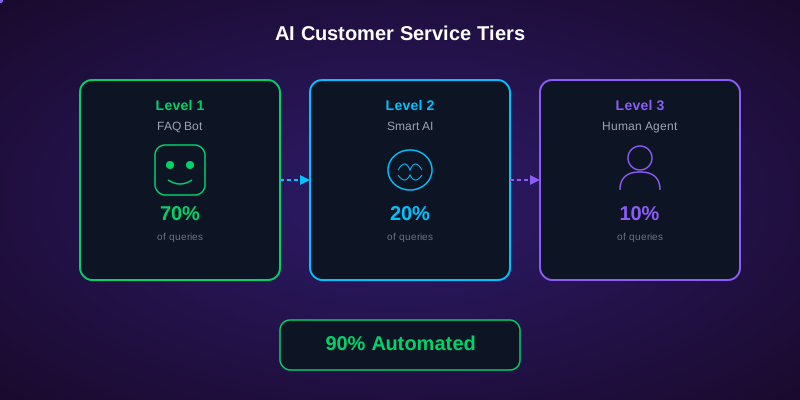
Three Levels of AI Customer Service
Not all AI support is created equal. Here’s what each level actually looks like in production.
Level 1: FAQ Bot (60% Deflection Rate)
This is where most businesses start. The AI answers common questions using your knowledge base. Store hours, return policies, shipping times, pricing. A well-trained FAQ bot typically deflects around 60% of incoming tickets.
Cost to implement: 500 to 2,000 EUR. Setup time: 1-2 weeks.
The catch: these bots fail the moment a question requires any context about the customer’s actual situation.
Level 2: Smart Assistant (80% Deflection Rate)
This is where things get interesting. The AI connects to your CRM, order management system, and customer database. It can look up a specific order, check inventory, verify account details, and personalize its responses based on purchase history.
A dental clinic we worked with went from answering 120 phone calls daily to 30. The AI handled appointment availability, insurance verification, and pre-visit instructions automatically.
Cost to implement: 3,000 to 8,000 EUR. Setup time: 3-6 weeks.
Level 3: Autonomous Agent (90% Deflection Rate)
The AI doesn’t just answer questions. It takes action. It processes refunds, reschedules appointments, updates shipping addresses, applies discount codes, and escalates edge cases to humans with full context attached.
This level requires deep integration with your business systems and careful guardrails. You don’t want an AI issuing refunds it shouldn’t.
Cost to implement: 8,000 to 25,000 EUR. Setup time: 6-12 weeks.
What Customers Actually Think
Here’s what the data shows: 74% of customers prefer AI for simple, transactional requests. Checking order status, resetting a password, getting store hours. They don’t want to wait in a queue for that.
But 68% of customers want a human for anything emotionally complex. Billing disputes, complaints, sensitive situations. And 81% get frustrated when they can’t reach a human at all.
The takeaway is straightforward. Use AI for speed and convenience on routine tasks. Keep humans available for the moments that require judgment, empathy, or creative problem-solving.
Implementation Roadmap: Start Small, Measure, Expand
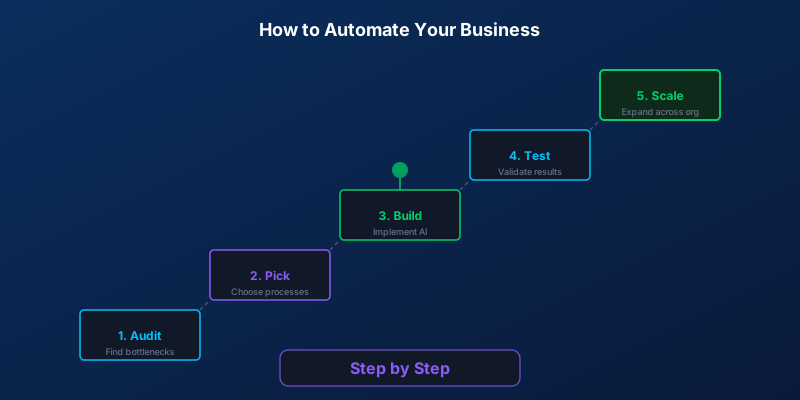
Week 1-2: Audit your tickets. Pull the last 500 support tickets. Categorize them. You’ll almost certainly find that 40-50% are repetitive questions with predictable answers. Those are your automation candidates.
Week 3-4: Build your knowledge base. Clean up your FAQs, product documentation, and policy pages. The AI is only as good as the data you feed it.
Week 5-6: Deploy a Level 1 bot. Start on your website chat only. Monitor every conversation. Look for patterns: where does the bot fail? What questions does it misunderstand?
Week 7-10: Iterate and connect systems. Based on real conversation data, expand the bot’s capabilities. Connect it to your CRM or order system if needed.
Week 11-12: Expand channels. Once the bot performs well on web chat, roll it out to WhatsApp, email, or other channels.
The Handoff Problem
This is where 70% of AI customer service implementations fail. The transition from AI to human is either too slow, too confusing, or completely absent.
Here’s what a good handoff looks like:
- Clear trigger points. The AI should recognize when it’s out of its depth. Sentiment analysis helps: if the customer’s frustration is escalating, hand off immediately.
- Full context transfer. The human agent should see the entire AI conversation, the customer’s account details, and the AI’s assessment of the issue. Nobody should have to repeat themselves.
- Warm transitions. “I’m connecting you with a specialist who can help with your billing concern” beats “Transferring you now” every time.
- Fallback option always visible. A “Talk to a person” button should be present from the start, not buried three menus deep.
Companies that nail the handoff see CSAT scores 23% higher than those that don’t.
Channel Breakdown: Where to Deploy AI Support
Website Chat
Best for: lead capture, product questions, order tracking. Conversion rates jump 15-25% when visitors get instant answers. Downside: only reaches people already on your site.
Best for: appointment reminders, order updates, quick Q&A. Open rates above 90% crush email. 2.7 billion active users globally. Downside: requires WhatsApp Business API setup, and message template approval can be slow.
Best for: complex inquiries, documentation-heavy responses. AI can draft replies for human review or handle straightforward requests autonomously. Downside: customers expect slower responses on email, so the speed advantage of AI matters less.
Voice AI (Phone)
Best for: appointment booking, basic inquiries, after-hours coverage. Modern voice AI handles natural conversation surprisingly well. Downside: still struggles with heavy accents, background noise, and multi-topic calls. Higher implementation cost.
Measuring Success: The Metrics That Matter
Track these four numbers weekly:
- Resolution rate. What percentage of AI conversations end with the customer’s issue solved, without human involvement? Target: 70%+ for Level 2 implementations.
- Customer satisfaction (CSAT). Survey customers after AI interactions. Anything above 4.0/5.0 is solid. Below 3.5 means something is broken.
- First response time. AI should respond in under 3 seconds. If you’re seeing delays, check your system integrations.
- Cost per ticket. The average human-handled support ticket costs 8 to 15 EUR. AI-handled tickets typically cost 0.50 to 2 EUR. Track this ratio as you scale.
Common Mistakes That Kill AI Customer Service
Making it impossible to reach a human. This is the fastest way to destroy customer trust. Every AI interaction needs an escape hatch. Always.
Training on bad data. If your knowledge base is outdated, riddled with errors, or contradicts itself, your AI will confidently give wrong answers. Garbage in, garbage out.
Set it and forget it. AI customer service needs ongoing maintenance. Products change, policies update, new questions emerge. Review AI conversations weekly and retrain monthly at minimum.
Over-automating sensitive situations. Cancellations, complaints, and billing disputes should default to human agents. Even if AI could technically handle them, the risk of a bad outcome is too high.
Ignoring tone and personality. A robotic, overly formal AI feels worse than no AI at all. Train your bot to match your brand voice. If your brand is casual and friendly, your AI should be too.
Cost Breakdown: What AI Customer Service Actually Costs
For a mid-size business handling 500 to 2,000 support requests per month:
| Component | One-Time Cost | Monthly Cost |
|---|---|---|
| Level 1 FAQ Bot | 500-2,000 EUR | 50-150 EUR |
| Level 2 Smart Assistant | 3,000-8,000 EUR | 150-500 EUR |
| Level 3 Autonomous Agent | 8,000-25,000 EUR | 400-1,200 EUR |
| Knowledge base creation | 500-2,000 EUR | Included |
| Ongoing optimization | Included | 200-600 EUR |
Most businesses break even within 2-4 months. A company spending 6,000 EUR monthly on three full-time support agents can typically reduce that to 2,000 EUR with AI handling tier-1 and tier-2 requests.
Who Should NOT Use AI for Customer Service
AI customer service isn’t right for everyone. Skip it if:
- You’re a luxury brand. Your customers pay premium prices and expect premium, human-only service. A chatbot greeting a client spending 10,000 EUR sends the wrong message.
- Your product is deeply technical B2B. If every support request requires an engineer to investigate, AI adds friction instead of removing it.
- You get fewer than 50 support requests per month. The ROI simply isn’t there. A shared inbox and one part-time agent will serve you better.
- Your knowledge base doesn’t exist yet. AI needs data to work from. If your documentation is nonexistent or severely outdated, fix that first.
- You’re in a heavily regulated industry with strict compliance requirements. Healthcare, finance, and legal services need careful guardrails before deploying AI. It’s doable, but the implementation cost and compliance overhead are significantly higher.
The Bottom Line
AI customer service in 2025 is practical, affordable, and genuinely useful for most businesses handling repetitive support requests. Start with a Level 1 bot, measure obsessively, and expand only when the data supports it.
The goal isn’t to eliminate human support. It’s to let your team focus on the conversations that actually need a human touch.
Talk to us about AI customer service for your business and we’ll show you exactly what can be automated today.
Writer at SORIX, the AI Automation Studio in Brussels. Building chatbots, voice agents, and automations for businesses across Europe and beyond.