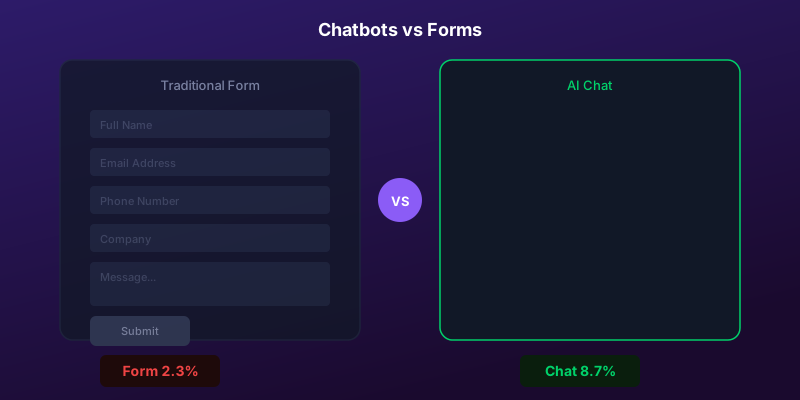
We tested both across multiple client websites. The results were decisive, and they changed how we approach every new project.
Contact forms have been the default lead capture method for two decades. Fill in your name, email, message. Hit send. Wait.
But here’s what the data actually shows: most visitors never complete the form.
The drop-off problem
Industry benchmarks put contact form completion rates between 3% and 5%. That means for every 100 visitors who land on your page, 95 to 97 leave without reaching out.
Why? Three reasons:
- Friction. Forms feel like work. Users have to decide what to write, structure their thoughts, and commit to a formal request.
- No instant gratification. After submitting, they get a “we’ll get back to you” message. No answers, no timeline, no engagement.
- One-size-fits-all. Whether someone wants pricing, a demo, or just has a question, they all get the same blank text box.
What happens when you add a chatbot
We ran A/B tests across 6 client websites over 3 months. Each site had both a contact form and an AI chatbot available. Here’s what we found:
| Metric | Contact Form | AI Chatbot |
|---|---|---|
| Engagement rate | 4.2% | 18.7% |
| Lead qualification | Manual | Instant |
| Avg. response time | 14 hours | 3 seconds |
| After-hours captures | 12% | 41% |
| Qualified lead rate | 31% | 67% |
The chatbot didn’t just collect more leads. It collected better leads. By asking qualifying questions in a conversational flow, it filtered out tire-kickers and surfaced high-intent prospects.
Why conversation beats forms
Humans are wired for dialogue. A chatbot feels like talking to someone, not filling out paperwork. Key advantages:
Immediate answers. The chatbot can respond to pricing questions, explain services, and share case studies in real time. No waiting.
Guided discovery. Instead of a blank field, the bot asks structured questions: “What industry are you in?” “What’s your biggest bottleneck?” This produces richer data than any form.
24/7 availability. 41% of chatbot leads came outside business hours. Those are leads your form would have lost.
Lower commitment. Clicking a chat bubble feels casual. Submitting a form feels official. Lower barrier means higher engagement.
The hybrid approach
We don’t recommend removing forms entirely. Some visitors, especially those doing research or procurement, prefer the structured format.
The winning formula we’ve seen:
- Primary CTA: AI chatbot (prominent, bottom-right, always visible)
- Secondary option: Traditional contact form on the /contact page
- Fallback: Email and phone in the footer
This way, every visitor type has a path that matches their preference.
Building a chatbot that actually converts
Not all chatbots are equal. The ones that convert share these traits:
- Personality that matches your brand. Professional but approachable. Never robotic.
- Qualifying questions upfront. Know what makes a lead valuable and ask for it naturally.
- Clear handoff. When the bot reaches its limits, it books a call or connects to a human. Seamlessly.
- CRM integration. Every conversation feeds directly into your pipeline. No copy-pasting.
- Multilingual support. Especially in Belgium, where Dutch, French, and English are all in play.
The takeaway
Forms still work. But they work like a suggestion box. A chatbot works like your best salesperson, available 24/7, never tired, never forgetful.
If your website gets traffic but not enough leads, the problem probably isn’t your offering. It’s your capture mechanism.
Want to see the difference on your own site? Get a free audit and we’ll show you exactly how many leads you’re leaving on the table.
Writer at SORIX, the AI Automation Studio in Brussels. Building chatbots, voice agents, and automations for businesses across Europe and beyond.